
Guide 001 · Vice presidents
Only ONE Vice President Has Done This Since 1836. Can Vance?
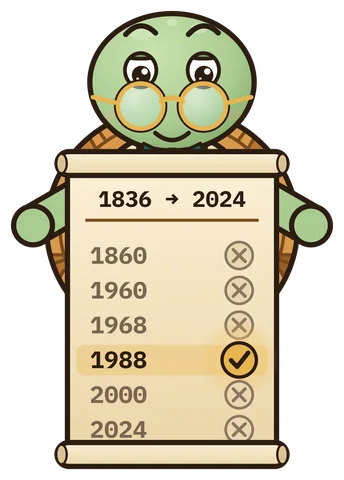
In the 188 years after Martin Van Buren’s 1836 win, through the 2024 election, George H.W. Bush (1988) was the only sitting vice president elected president.
Facts as of 13 November 2026

The short answer
1/6sitting VP nominees won since 1836
What “this” means: a sitting vice president elected president. Not by succession (nine vice presidents took over that way), and not as a former vice president (Nixon in 1968, Biden in 2020).
Since Van Buren won in 1836, six sitting vice presidents were nominated and one won. George H.W. Bush beat Michael Dukakis 426 to 111 in the Electoral College in 1988. Breckinridge (1860), Nixon (1960), Humphrey (1968), Gore (2000) and Harris (2024) lost.
Van Buren to Bush is a 152-year gap. Three more sitting vice presidents tried for their party’s nomination and didn’t get it: Fairbanks (1908), Garner (1940) and Barkley (1952).
And Vance? JD Vance is the sitting vice president. His term ends at noon on 20 January 2029 (20th Amendment), so he would still be a sitting vice president during the 2028 election. The record is a pattern, not a law: it rests on only nine cases.
Footnote. George Clinton, 1808: a sitting vice president. Six New York electors backed him for president (6 of New York’s 19; 13 went to Madison), and he was re-elected vice president with 113. The caucus nominated him for vice president, not president, so he isn’t counted here.
The scoreboard since 1836
| Year | Sitting VP | Result | Electoral votes |
|---|---|---|---|
| 1860 | John C. Breckinridge | ✕ Lost | Lincoln 180, Breckinridge 72, Bell 39, Douglas 12 |
| 1960 | Richard Nixon | ✕ Lost | Kennedy 303, Nixon 219, Byrd 15 |
| 1968 | Hubert Humphrey | ✕ Lost | Nixon 301, Humphrey 191, Wallace 46 |
| 1988 | George H.W. Bush | ✓ Won | Bush 426, Dukakis 111 |
| 2000 | Al Gore | ✕ Lost | Bush 271, Gore 266 |
| 2024 | Kamala Harris | ✕ Lost | Trump 312, Harris 226 |
Watch the video
The video will appear here when it is published on our YouTube channel.
Full source list
Every source, by topic
Every fact in the video traces back to one of these. The YouTube description has room for the key ones; this is the complete list.
63 sources 57 links 6 books
- The Constitution and the rules
- Results for every election, and every vice president
- 1796 and 1800
- 1808
- 1836 and 1840
- 1860
- 1904 to 1952
- 1960 to 1968
- 1984 and 1988
- 2000
- 2020 and 2024
- 2028
- Why sitting vice presidents lose
- Books and scholarship (cited generally)
- Pictures and visual references
The Constitution and the rules
- The Constitution of the United States (transcript)National ArchivesArticle II: a president must be a natural-born citizen, at least 35, and 14 years a resident; the original two-vote system for electors.
- The Constitution: Amendments 11–27National ArchivesThe 12th Amendment (ratified 15 June 1804); the 20th (terms end at noon on 20 January); the 22nd (limits presidential terms only).
- Amending the Electoral College: the 12th AmendmentNational Archives, Prologue blogWhy the original two-vote system was replaced after the 1800 tie.
- About the Electoral CollegeNational ArchivesHow electors are allotted and how their votes are counted.
- The Electoral College: origins and developmentHistory, Art & Archives, U.S. House of RepresentativesBackground on how the Electoral College has worked over time.
Results for every election, and every vice president
- Electoral College resultsNational ArchivesElectoral votes for every year cited in the video.
- Election statisticsHistory, Art & Archives, U.S. House of RepresentativesOfficial election statistics compiled by the Clerk of the House.
- Election results and voting informationFederal Election CommissionIndex of official federal election results.
- Vice Presidents of the United States, 1789–1993 (S. Doc. 104-26)U.S. Senate Historical Office, via GovInfo (GPO)Biographies and terms of the vice presidents in this guide: Adams (1789–1797), George Clinton (1805–1812), Van Buren (1833–1837), Breckinridge (1857–1861), Fairbanks (1905–1909), Garner (1933–1941), Barkley (1949–1953), Nixon (1953–1961), Humphrey (1965–1969) and George H.W. Bush (1981–1989), each sitting in the election year cited.
- Vice presidents of the United StatesU.S. Senate Historical OfficeThe full list of vice presidents and their terms.
- The American Presidency ProjectUniversity of California, Santa BarbaraReference archive of presidential documents and election data.
1796 and 1800: the original two-vote system
- 1796 Electoral College resultsNational ArchivesAdams 71, Jefferson 68: 138 electors, two votes each. Adams was elected while serving as vice president.
- 1800 Electoral College resultsNational ArchivesJefferson 73, Burr 73: a tie, sending the choice to the House.
- The 1800 election in CongressNational ArchivesThe House chose Jefferson on the 36th ballot, 17 February 1801.
- Papers of Thomas JeffersonFounders Online, National ArchivesJefferson’s own papers from the 1800–01 contest (primary source).
1808: George Clinton (footnote)
- 1808 Electoral College resultsNational ArchivesMadison 122, C.C. Pinckney 47, Clinton 6; New York split 13 Madison, 6 Clinton; Clinton re-elected vice president with 113.
1836 and 1840: Martin Van Buren
- 1836 Electoral College resultsNational ArchivesVan Buren won 170 of 294 electoral votes as the sitting vice president.
- When the Senate elected the vice presidentU.S. Senate Historical OfficeThe Senate elected Richard M. Johnson vice president on 8 February 1837, 33 to 16, the only time it has done so.
- Martin Van Buren: campaigns and electionsMiller Center, University of VirginiaVan Buren was Jackson’s chosen successor; he lost re-election in 1840.
- Martin Van Buren: domestic affairsMiller Center, University of VirginiaAn economic crisis often called the Panic of 1837 came shortly after Van Buren took office.
- 1840 Electoral College resultsNational ArchivesHarrison 234, Van Buren 60 (294 electors).
1860: John C. Breckinridge
- 1860 Electoral College resultsNational ArchivesLincoln 180, Breckinridge 72, Bell 39, Douglas 12.
- The expulsion of John C. BreckinridgeU.S. Senate Historical OfficeHe ran as the candidate of the Southern Democratic party; later a Confederate general; the Senate expelled him on 4 December 1861.
1904 to 1952: succession, and vice presidents who couldn’t get nominated
- 1904 Electoral College resultsNational ArchivesTheodore Roosevelt, who became president by succession, was elected in his own right.
- Charles W. FairbanksMiller Center, University of VirginiaFairbanks sought the 1908 nomination; Theodore Roosevelt used his power and popularity to secure Taft’s nomination.
- John Nance Garner (featured biography)U.S. Senate Historical OfficeBackground on Garner’s Senate and vice-presidential career.
- John Nance Garner, vice president 1933–1941Miller Center, University of VirginiaGarner announced his own run in December 1939, against Roosevelt’s third term; Roosevelt won the nomination.
- Kentucky timelineU.S. Senate Historical OfficeBarkley withdrew on 22 July 1952 after labor leaders saw his age as an obstacle.
- Alben W. Barkley (party leadership)U.S. Senate Historical OfficeBarkley’s Senate leadership career.
1960 to 1968: Nixon and Humphrey
- 1960 Electoral College resultsNational ArchivesKennedy 303, Nixon 219, Byrd 15 (537 electors; 269 to win).
- United States presidential election of 1960Encyclopædia BritannicaThe popular-vote margin was about 0.2%.
- 1964 Electoral College resultsNational ArchivesThe first election with today’s 538 electors and 270 to win; Lyndon Johnson, who became president by succession, was elected in his own right.
- 1968 Electoral College resultsNational ArchivesNixon 301, Humphrey 191, Wallace 46. Nixon won as a former vice president.
- Divisions at the 1968 Democratic conventionMiller Center, University of VirginiaJohnson announced on 31 March 1968 he would not seek re-election; violent clashes outside the Chicago convention; Humphrey nominated on the first ballot.
1984 and 1988: George H.W. Bush, the exception
- 1984 Electoral College resultsNational ArchivesWalter Mondale ran as a former vice president.
- 1988 Electoral College resultsNational ArchivesBush 426, Dukakis 111, and one West Virginia elector voted for Bentsen.
- Remembering President George H.W. BushNational ArchivesBush “became the first sitting Vice President to be elected President since Martin Van Buren in 1836.”
- “Bush and history” (15 October 1987)The Christian Science MonitorThe quote “History, in sum, has been hard on No. 2 men.”
2000: Al Gore
- 2000 Electoral College resultsNational ArchivesBush 271, Gore 266; one D.C. elector cast a blank ballot (abstained).
- Federal Elections 2000: presidential results by state (PDF)Federal Election CommissionGore won the national popular vote by 543,895.
- Albert Gore, Jr.: vice president, 1993–2001Miller Center, University of VirginiaGore was the sitting vice president and ran for president in 2000; he won the popular vote but not an electoral majority.
- Bush v. Gore, 531 U.S. 98 (2000)Library of CongressThe Supreme Court decision of 12 December 2000.
2020 and 2024: Biden and Harris
- 2020 Electoral College resultsNational ArchivesJoe Biden won as a former vice president.
- 2024 Electoral College resultsNational ArchivesTrump 312, Harris 226.
- Official 2024 presidential general election results (PDF)Federal Election CommissionOfficial 2024 vote totals.
- Kamala D. Harris (Biographical Directory)Biographical Directory of the U.S. CongressHarris’s official biography.
- Biden’s letter withdrawing from the race (21 July 2024)NPRHarris became the nominee after Biden withdrew on 21 July 2024.
- Harris election would defy history (2024)PBS NewsHour / Associated PressNews reporting on how rarely a sitting vice president has been elected president.
2028: JD Vance
- Vice President JD VanceThe White HouseVance is the sitting Vice President of the United States.
- JD Vance (Biographical Directory)Biographical Directory of the U.S. CongressVance’s official congressional biography.
- JD VanceEncyclopædia BritannicaBorn 2 August 1984; meets Article II’s age requirement.
Why sitting vice presidents lose: polls and research
- Ronald Reagan from the people’s perspectiveGallupReagan’s final approval ratings: 57% in mid-November 1988, 63% in December 1988.
- US business cycle expansions and contractionsNational Bureau of Economic ResearchThe economy was in a long expansion in 1988 (November 1982 to July 1990).
- Abramowitz’s “Time for Change” model (Emory Report, 2008)Emory UniversityA party seeking a second-or-later straight term in the White House takes a penalty of more than 4 points.
- The Fair modelRay C. Fair, Yale UniversityBackground on economy-based election forecasting.
Books and scholarship (cited generally)
- The Modern American Vice PresidencyJoel K. Goldstein, Princeton University Press, 1982How the vice presidency changed in the 20th century.
- The White House Vice PresidencyJoel K. Goldstein, University Press of Kansas, 2016The modern vice president’s role inside the White House.
- The American Vice Presidency ReconsideredJody C. Baumgartner, Praeger, 2006Scholarship on vice presidents and their later careers.
- “Time for Change” forecasting modelAlan I. Abramowitz, PS: Political Science & Politics, 1988The original paper behind the “time for change” penalty.
- The Responsible ElectorateV.O. Key Jr., 1966Retrospective voting: voters judge the party in power on its record.
- Retrospective Voting in American National ElectionsMorris P. Fiorina, Yale University Press, 1981Retrospective voting: voters judge the party in power on its record.
Pictures and visual references
- Vice presidential bust collectionU.S. SenateReference for images of vice presidents (rights checked separately; not a fact source).
- Prints & Photographs Online CatalogLibrary of CongressReference for historical images (rights checked item by item; not a fact source).
Some official sites (the Biographical Directory of Congress, the Library of Congress) block automated link checkers; their pages open normally in a browser. Links open in a new tab.
How this was made
Narrated with a licensed AI voice. Researched and drafted with AI tools; every fact is checked against the sources below and approved by a person before publishing.
Spotted an error? Tell us.
Email hello@civicformula.com with the fact, the time in the video and a source. We fix mistakes in the open and note every correction.

Independent. Not affiliated with any party, campaign, candidate or government agency.